
Dorchester Deed Types Explained
Every land-record instrument filed in Dorchester County lands with the Dorchester Circuit Court Clerk's Land Records Department. Deeds sit alongside mortgages, deeds of trust, leases, releases, and land contracts. The instrument type tells you what the filing was designed to accomplish. Before placing any document in a parcel's chain, read the parties, the granting clause, the legal description, the signatures, the recording stamp, and any prior references.
| Deed Type | What It Does | Common Use |
|---|---|---|
| General warranty deed | Transfers the stated estate with broad covenants | Conventional sale |
| Special warranty deed | Limits covenants to claims through the grantor | Commercial or fiduciary transfer |
| Quitclaim deed | Transfers whatever interest the grantor holds | Family transfer or interest cleanup |
| Trustee or representative deed | Transfers through trust or estate authority | Trust administration or probate sale |
| Tax-sale deed | Follows statutory tax-sale proceedings | Final delinquent-tax transfer |
A mortgage or deed of trust is not a deed of ownership. Neither is a lien or a release. These instruments record claims, security interests, or satisfactions attached to the land, and searching that family of records tells you whether an old mortgage was released or a judgment ever touched the parcel.
MDLandRec Deed Search Controls
MDLandRec is the state's remote gateway to the deed index and images. Its fall 2025 release requires a new account and reaches deeper than a simple surname. That depth matters here, because Dorchester deed records are full of repeated family names, corporate parties, trusts, and estates.
| Control | Choice or format | Purpose |
|---|---|---|
| County | Select Dorchester | Limits the land index |
| Party name | Last/corporation, first, middle, suffix | Finds people and entities |
| Name modifier | Is, begins, ends, contains, fuzzy or Soundex | Handles spelling variation |
| Ownership | All, corporation, individual | Narrows party class |
| Party type | All, grantor, grantee | Sets transfer direction |
| Instrument/date | Type, remarks, cross-reference, range | Separates likely matches |
| Book/Page | Direct volume and page | Opens a known citation |
Pricing on MDLandRec splits by age. Records newer than 100 years cost $0.20 per remote page. Older pages stay free. Accessed pages remain in your account for 30 days. Downloaded pages are yours to keep. Check the live notice. Prices can change. The current MDLandRec entry screen shows the account gateway that comes before the county and index controls.
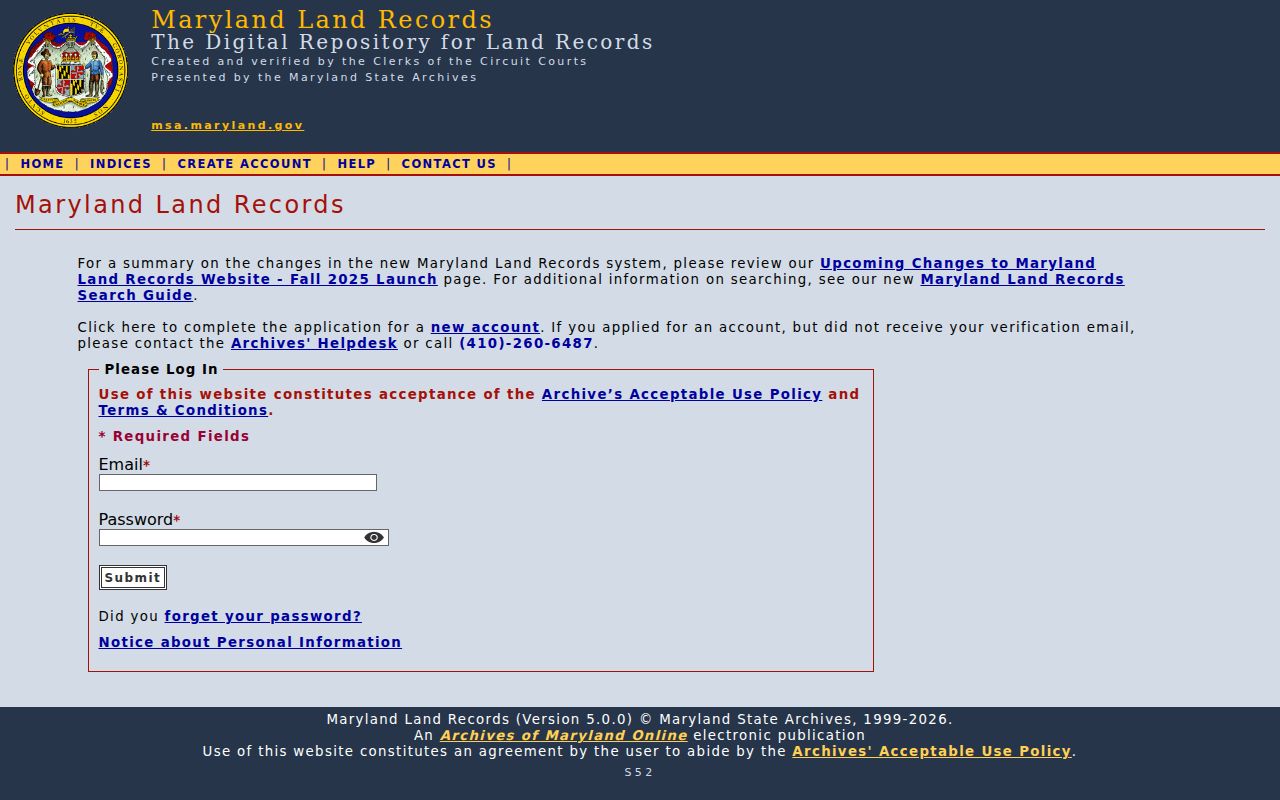
Once you are signed in, preserve the county, instrument, book, page, and access date with every saved image.
Dorchester's Grantor-Grantee Chain
Every deed has two sides. The grantor transfers the interest, and the grantee receives it. Start your chain from the newest confirmed deed. Search the current owner's indexed name as grantee. Open the likely acquisition and compare its legal description and prior deed reference against the assessed parcel. Then make the seller named in that deed your next grantee search.
- Use SDAT's Owner Name and deed Liber/Folio as the starting citation.
- Open that deed and record the grantee, grantor, date, consideration, and description.
- Search the grantor as an earlier grantee, allowing initials, estate labels, and company variants.
- Confirm the same land through acreage, tract, lot, plat, road, and adjoining-owner terms.
- Repeat until the name index ends, then use scanned indexes and Jump to New Volume.
- Grantor
- The party transferring the stated interest.
- Grantee
- The party receiving that interest.
- Chain of title
- The ordered series of instruments linked to the same land.
- Book and page
- The Liber/Folio citation used to retrieve a recorded image.
Dorchester Deed Access Channels
MDLandRec is the first remote route, but it is not the only route. The Clerk maintains a public research room at the Dorchester County Courthouse, 206 High Street, Cambridge. Regular hours are 8:30 a.m. to 4:30 p.m. Monday through Friday. The general office number is 410-228-0481, and the land-record line is 410-228-0480. Counter research is useful when an image is faint, an index entry is unclear, or the needed book does not appear through an ordinary web query.
The Clerk's official land-record page summarizes the public-room route, surviving record depth, fees, and record types.
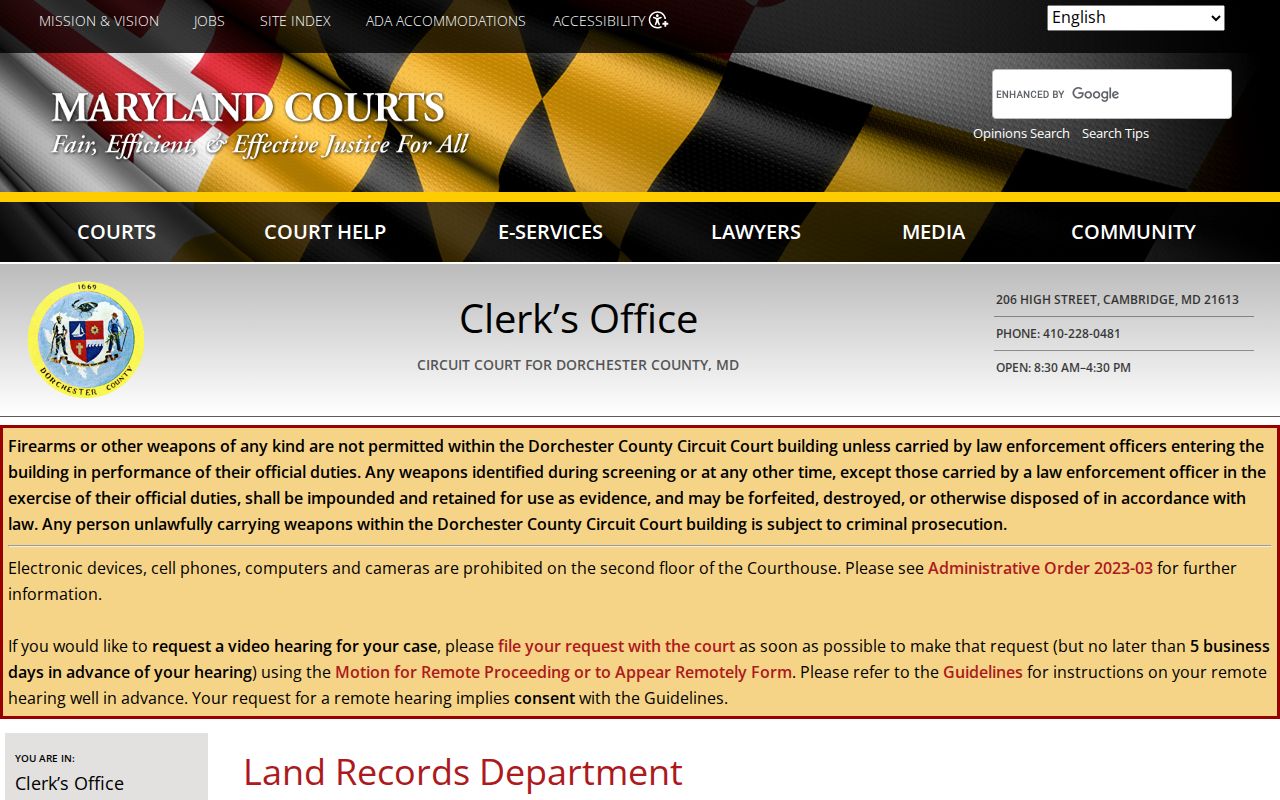
Mail or staff-assisted copy requests work best with a precise citation. Name the grantor and grantee. Give the recording date, instrument type, and book/page. Say whether a plain copy will do or certification is required. The Clerk supplies records but runs no title search and offers no advice on what an instrument means.
Historic digging can continue through Maryland State Archives catalogs, research rooms, paper volumes, and microfilm. Closer to home, the Dorchester County Public Library Maryland Room bridges assessment records, maps, directories, newspapers, and land-record material. A later deed may surface the old tract name. So may an obituary, an assessment, or a map. Any of these can reopen a stalled archival index. The right spelling of a party helps too.
Treat every failed search as carefully as a successful one. Note the name form, the party direction, the date range, the county, the instrument filter, and the source. A blank remote result can reflect an index boundary. It can also reflect a spelling quirk, a retired volume, or record loss. None of these means a true absence of ownership history.
Keep the index and the image separate in your records. The index is only a finding aid. The instrument image carries the operative wording and the description. It also carries the signatures, the acknowledgments, the tax stamps, and the recording references. A certified copy authenticates the custodian's version. Certification never turns the Clerk into a title examiner.
Much Dorchester land is described by tract rather than street, so build a name ladder. Record the current owner and the prior grantor. Add the estate, the farm or tract, the creek, and the road. Include the town, the plat name, and the adjoining owners. Search each term in whichever source accepts it. The county's archival plat entries prove the point. The same ground can sit under an owner, an addition, a town, a company, or a road. Preserve each rejected match and the fact that ruled it out.
When a deed cites a release, a prior deed, a plat, or a public-works agreement, pull that cross-reference too. Chains are not always neat lines of sale deeds. Mortgages, releases, and estate instruments can explain a gap. Lot-line changes and road dedications can explain a shift in the legal description.
Dorchester Records After 1852
A courthouse fire on May 9, 1852 destroyed many Dorchester County records. The loss changes how you search. It does not end the search. Later Dorchester County property records often recite earlier ownership. Duplicate books, grantor and grantee indexes, land commission papers, tax assessments, patents, plats, and microfilm can rebuild stretches of a chain of title.
The Clerk reports surviving land records reaching back to 1665. Archives catalogs list CE46 covering 1669 through 1851. CE49 serves as a grantee index for 1818 to 1951. CE50 is a grantor index for 1669 to 1819. CE81 covers grantors from 1819 to 1951. Handwriting, odd spelling, or damage can defeat one index. The overlapping paper and microfilm series then give you another route into the same deed records.
The Maryland Room collects county assessment records, land records, maps, directories, local-government documents, and microfilm. Appointments and sign-in are preferred. Digitization work in 2025 can affect access to some materials.
Note: Label each old source as original, duplicate, microfilm, or reconstructed evidence. Do not treat every image as equal.
Plats Expand Dorchester Deeds
A deed may cite a plat without reproducing its map. Search Dorchester PLATS.NET by book, page, plat, or box number. Advanced controls add date, description, clerk initials, and sort order. The series search reaches subdivision, division, road, wetland, land-commission, patent, and right-of-way records. So a single plat number can open records a deed alone never shows.
Named entries like Dundean Addition to Cambridge, Overbrook Park Addition to Hurlock, and West Secretary Subdivision can preserve land names. No modern street address carries those names. Road plats and public-works agreements may explain access, dedications, narrow remnants, or later parcel consolidation.
Dorchester Recording Costs
The Clerk's posted schedule splits filing charges from copy charges. Plain copies run $0.50 per page. Certification costs $5 per document plus the copy fee. Notary authentication is $1. A release up to nine pages costs $10 to record. Many short instruments cost $20. Other instruments of ten or more pages cost $75. Most instruments also carry a $40 surcharge with listed exceptions.
Recordation tax is $5 per $500, rounded up. The state transfer tax sits at 0.50%. It drops to 0.25% with a first-time Maryland homebuyer affidavit. The county transfer tax is 0.75%. The first $30,000 is exempt for an owner-occupant who files the affidavit. None of these charges covers the separate price of remote images.
Format rules demand black type of at least eight points. They require a three-inch top margin on the first page. Side margins must be one inch. Noncompliant documents may draw triple fees. A transfer may also need verification from Finance or a municipality. The Clerk will not record it before then.
Check Dorchester Deed Fraud
The Maryland Insurance Administration advisory urges owners to check public deeds periodically. Monitoring can alert an owner once something is filed. It cannot stop the filing itself. Dorchester County offers no deed-alert signup, so search the official index directly rather than assuming such a service exists.
Report a suspicious filing through the channels the advisory names, whether the Clerk, law enforcement, a lender or title insurer, regulators, consumer protection, or FBI IC3. Keep the instrument citation and image.
Get a Dorchester Deed Copy
Remote users can pull images through MDLandRec. Prefer the counter? The public research room sits inside the Dorchester County Courthouse, 206 High Street, Cambridge, open weekdays from 8:30 a.m. to 4:30 p.m. Reach the general office at 410-228-0481 or the land-record line at 410-228-0480.
Whether by mail or at the counter, a tight request names the parties, the recording date, the instrument type, and the book and page, plus whether you want a plain or certified copy. The Clerk welcomes self-research but draws the line at title searches and legal advice. Older material may demand the courthouse, the Archives, a library, or a request tied to a named series.
Recorded, not guaranteed. Dorchester County deed records show filed instruments. They do not disclose every unrecorded interest or provide a legal conclusion about clear title.