
Dorchester Tax Record Fields
Every lookup starts with the SDAT Real Property Search and ends with County Finance. The roll tells you what gets assessed. Finance tells you what gets billed and collected. Keep the account identifier and tax year attached to anything you save.
| Field | What It Shows | Where |
|---|---|---|
| Current value | Full-cash assessment at the current cycle | SDAT parcel card |
| Land and improvements | Components of the assessed property value | SDAT parcel card |
| Residence and credits | Principal-residence, homestead, credit, and exemption fields | SDAT and credit records |
| Tax district and rate | State, county, municipal, and special-area context | County taxpayer sheet |
| Bill and payment | Installment schedule, amount, payment, or delinquency | Finance/Treasury |
| Tax sale | Sale result, redemption, and later legal process | County tax-sale records |
Maryland law sets real property assessments at full market value across Dorchester County. Revaluations follow a three-year cycle. The two figures look similar but mean different things. "Price/Consideration" records what a transaction actually brought, while "Current Value" is the official assessment. The bill then applies rates and adjustments to taxable value. Treat the three numbers as distinct, not interchangeable.
Search Dorchester Assessment Values
SDAT lets you search by address, street name, account identifier, or map reference. Owner name, town, subdivision, and ZIP are not search fields. If an exact house number fails, drop the number. Search the street alone. Add a trailing asterisk. From the results, pick the parcel carefully. Its premises address, map, parcel number, and legal description should all agree.
| Owner Name | Name shown from the last recorded deed |
|---|---|
| Premises Address | Physical address assigned by local government |
| Mailing Address | Destination for assessment notices and tax bills |
| Account Identifier | Stable key for the assessed parcel |
| Value fields | Land, improvements, base value, and current value |
| Relief fields | Principal residence, homestead, tax credits, and exemptions |
For an appeal, work from the assessment notice itself. The online parcel card is useful evidence. But the notice carries the control and notice numbers the electronic appeal form demands.
Never read payment status off the assessment page. SDAT tracks valuation and property characteristics; Dorchester Finance tracks the bill. When you call, name the fiscal year. Ask whether the figure is an annual installment, a semiannual installment, a credit adjustment, or a delinquent balance. Write down the response date, since interest and collection status shift.
A recent sale can leave the owner, deed reference, and tax account out of line. Recording, roll maintenance, and billing each run on separate workflows. So compare the newest recorded deed before assuming a mistake. Give both offices the old and new owner names. Include the account identifier and the transfer date.
Note: A mailing address outside Dorchester County does not place the assessed parcel outside Dorchester County.
Dorchester Tax Rates and Dates
County taxpayer information puts bill mailing in July. Annual payments are due September 30. Eligible owner-occupied accounts can elect semiannual billing, with installments due September 30 and December 31. A bill that never arrives in the mail still comes due.
For FY2025-26, the state rate is $0.112 per $100 of assessed value. The county rate is $1.03. The Cambridge municipal rate is $0.9567. Municipal and special-area rates hinge on the fiscal year and the parcel's jurisdiction. Dorchester collects for Brookview, Cambridge, Church Creek, East New Market, Eldorado, Galestown, Hurlock, Secretary, and Vienna.
Before calculating anything, open the current Dorchester Finance and Treasury tax page. Rates, caps, and dates change from year to year.
Look Up a Dorchester Tax Bill
Dorchester County publishes no current public online bill search. The old tax database address circulating in an earlier municipal PDF is obsolete, so skip it. Identify the parcel in SDAT first, then call Dorchester Finance at 410-228-4343 or visit 501 Court Lane in Cambridge for account-specific billing and payment details.
- Find the exact parcel in SDAT and copy its account identifier, address, owner, and tax district.
- Ask Finance for the bill by account and tax year, including annual or semiannual status.
- Compare credits, exemptions, and principal-residence fields with the assessment record.
- Confirm payment, delinquency, interest, and any tax-sale status directly with Finance.
- Assessed value
- The official value used as the starting point for taxation.
- Tax rate
- The charge applied per stated unit of assessed value.
- Homestead credit
- A limit on taxable-assessment growth for an eligible principal residence.
- Tax lien
- The government's claim securing unpaid property tax.
Dorchester Homestead and Credits
The homestead credit caps how fast a taxable assessment can grow. It applies to an eligible principal residence. It does not freeze market value or erase the tax. For FY2025, Dorchester County and its remaining municipalities apply a 5% homestead cap. Confirm the cap that fits your parcel's jurisdiction and tax year.
SDAT also runs the Homeowners' Property Tax Credit. County materials point to senior relief plus reductions for qualifying disabled veterans and blind owners. Each program carries its own ownership, occupancy, income, disability, and filing rules. A checked box on the parcel card is not an eligibility decision. It is also not an approval letter.
Line up the principal-residence field and Homestead Application Status first. Add Homeowners' Tax Credit, exemptions, and special tax areas side by side. A credit you expected may be missing. Ask SDAT which form and year control the outcome. Guessing a subtraction against the bill only muddies the numbers.
Dorchester Delinquency and Tax Sale
Unpaid property tax can slide from delinquency into the county's annual tax sale. The county posts tax-sale notices and results. But a sale result is not a deed. Dorchester's terms include 10% annual interest and a four-month redemption window. A six-month-and-one-day threshold applies to further legal action. No over-the-counter tax-sale purchases are available.
Whether you own the parcel or are bidding, verify the account, sale date, purchaser certificate, redemption figure, and court status with the responsible offices. Redemption or a later foreclosure action can change everything. Search the Circuit Court case record. Search the land records for any judgment or deed that follows.
The official county tax page is the starting point for current notices and contact instructions.
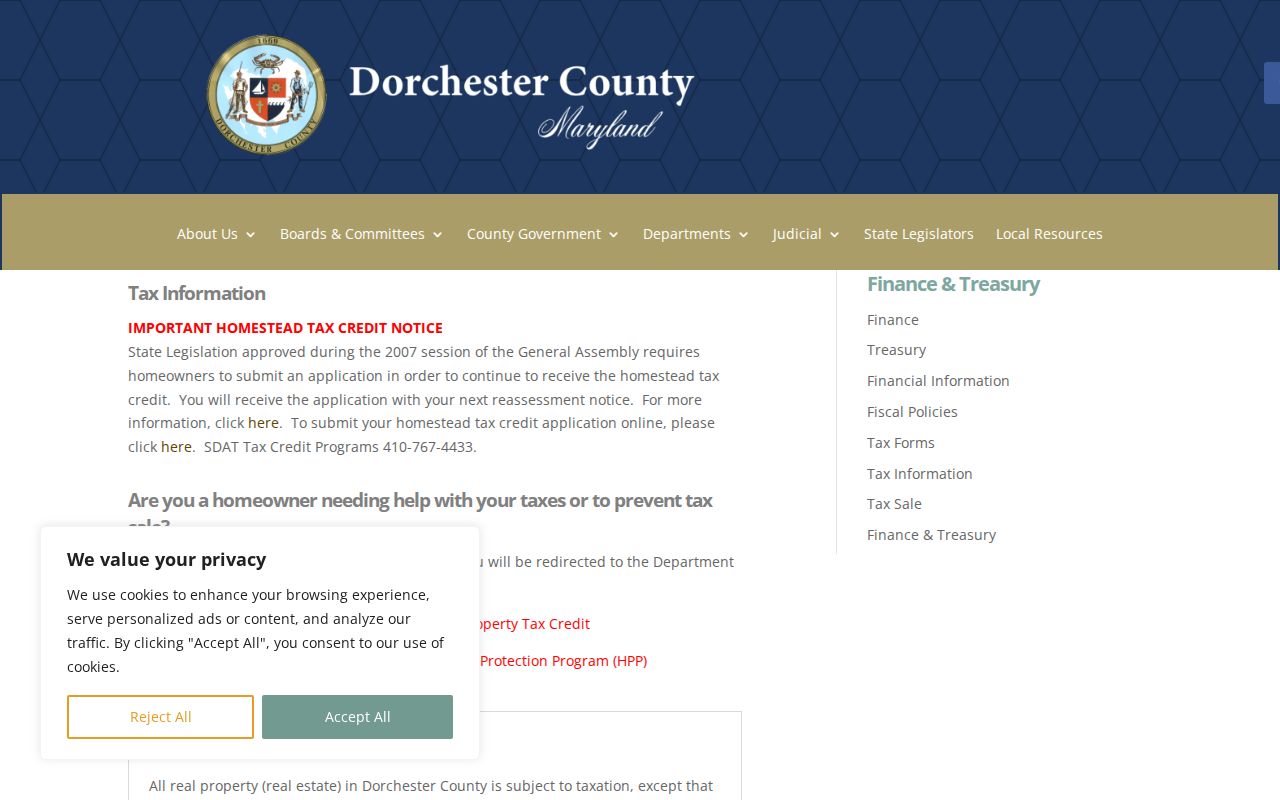
The county's official tax-information page shows the billing route for Dorchester County property tax records. Verify live terms before acting on a delinquent account.
Note: A tax-sale certificate starts a statutory process and does not by itself establish that the certificate holder owns the parcel.
Current Value Versus Sale Price
SDAT's Current Value is the latest full-cash assessment in the three-year cycle. Land and Improvements make up its parts. Base Value drives the phase-in math and year-over-year comparisons. Price or Consideration comes from the transfer record instead.
That gap matters when you read Dorchester County property tax records after a sale. A deed can record before the next assessment cycle arrives. Family conveyances and estate deeds often report consideration far from open-market value. The tax rate moves the bill. It never changes the underlying market evidence.
For a fair comparison, hold the valuation date, cycle, transfer date, and tax year together. Use SDAT's Area Sales Listing to compare similar parcels. One nearby sale does not set every value. Lot size, improvements, use, condition, waterfront setting, flood or Critical Area limits, and municipal jurisdiction create real differences. When SDAT's physical facts are wrong, gather photos, plans, permits, or a survey and raise the error through the proper appeal route.
Pending Permit and Last Notice of Major Improvement fields often explain why the roll is shifting. They are clues, not the whole permit file. Request the county or municipal record itself when construction, demolition, or a change of use affects the value question.
Appeal a Dorchester Assessment
The SDAT Real Property Assessment Appeal Form opens with three fields: County, Notice Number, and Control Number. The last two sit on the assessment notice. A new market value has a 45-day window. The clock runs from the notice date. The online form cannot be used for property the requester does not own.
First-level hearings may be written, by telephone, by video, or in person. A Petition for Review covers the two years outside the regular reassessment cycle. A purchaser between January 1 and June 30 may have a 60-day new-owner route. The deed must be recorded first. Evidence may include the property worksheet, area sales, photos, and repair estimates. Income and expense records count where relevant. Facts showing a classification or description error do too.
A supervisor-level final notice may be appealed to the Property Tax Assessment Appeals Board. The deadline is 30 days. No fee applies. The next stop is the Maryland Tax Court. That filing is due within 30 days of the board's order.
The official appeal process page explains the available filing points. It maps every review level.
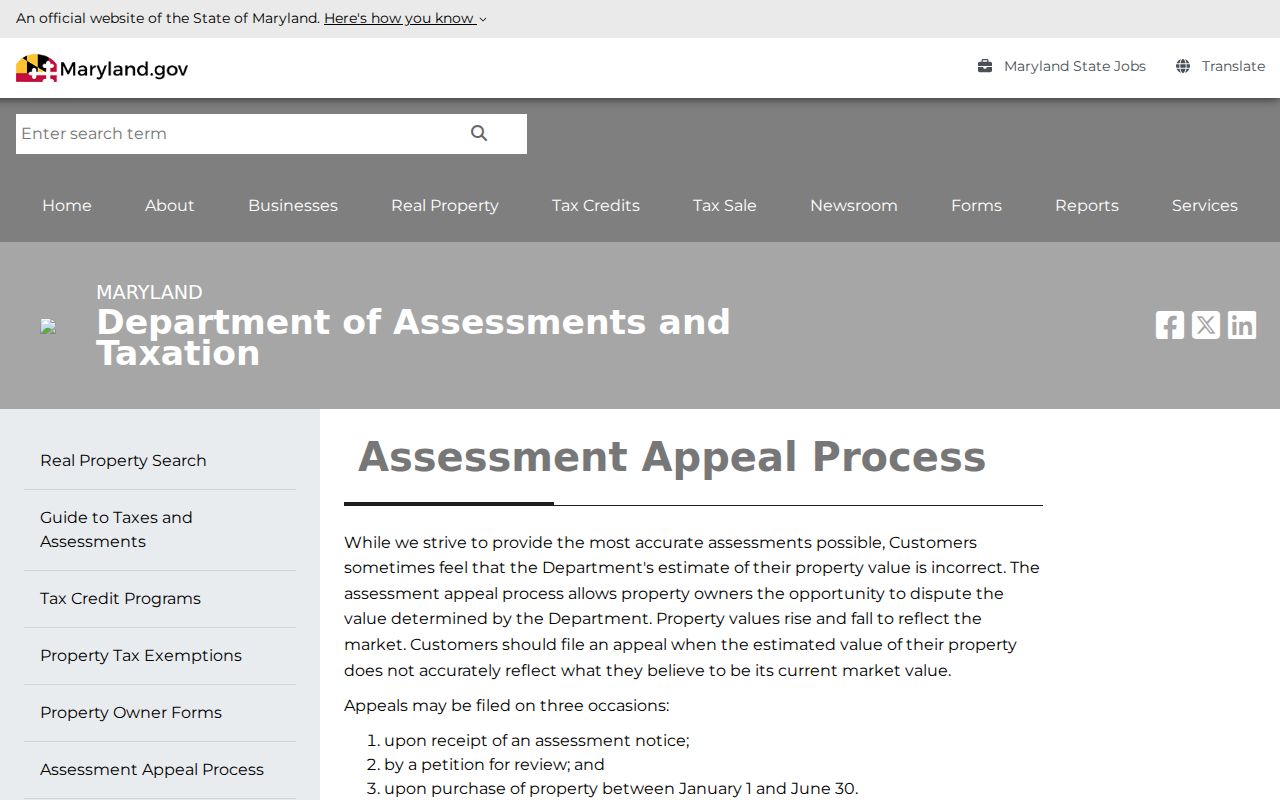
The appeal paths vary. Each fits a different notice: reassessment, petition, new-owner, PTAAB, or Tax Court. The online appeal entry form displays the identification fields and the filing warning.
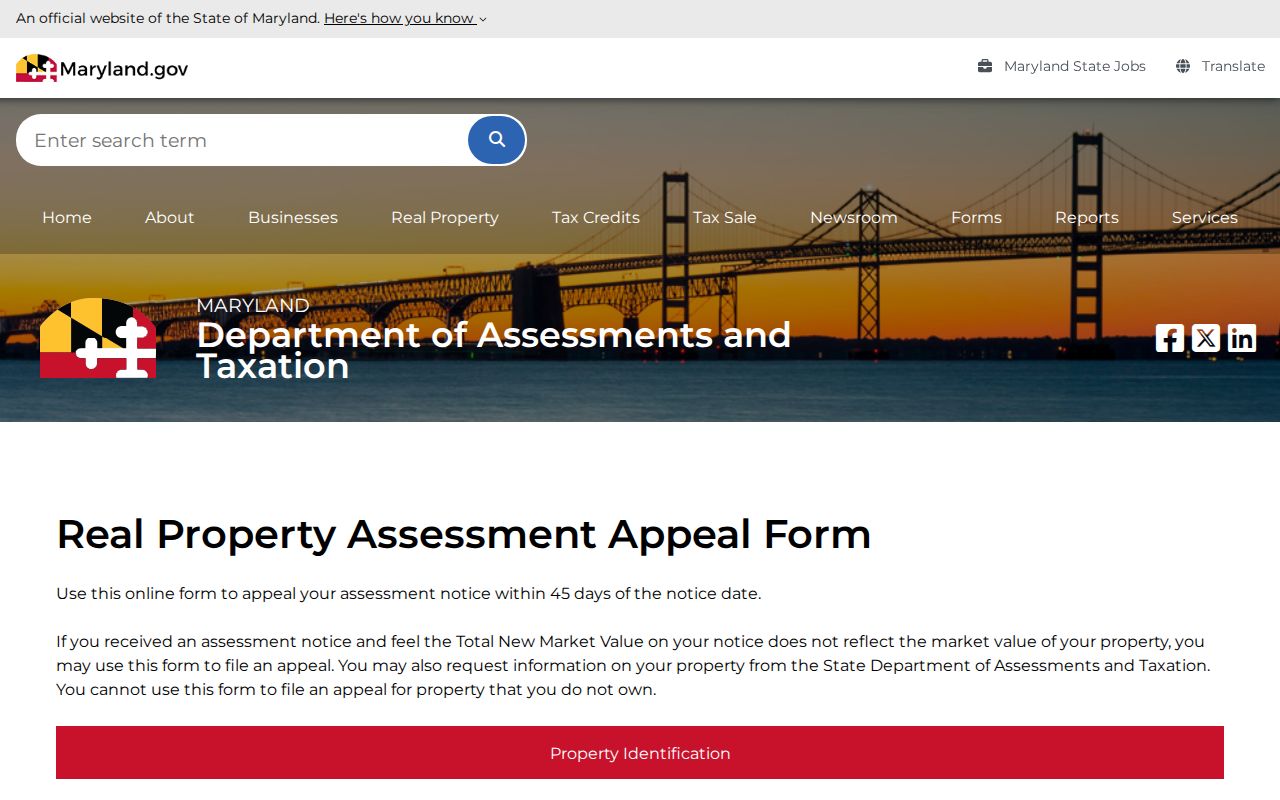
Have the notice in hand before opening the form. The notice and control numbers identify the property and assessment under review.
Appeal window. File a reassessment appeal within 45 days of the notice date. Later levels generally have 30-day deadlines, so use the date on each decision.